How Long Does a TPE Procedure Take? What to Expect
How Long Does a TPE Procedure Take? What to Expect
In our busy lives, knowing how much time to budget for medical appointments is essential. Whether you are fitting a treatment in before work, during a lunch break, or planning your day around it, a common question we receive is: "How long does a TPE procedure take?"
The short answer is: 90 to 120 minutes on average.
But as with any medical procedure, the "chair time" is just one part of the equation. Several factors—including your height, weight, vein quality, and the specific protocol prescribed—can influence the total duration.
In this detailed breakdown, we will walk you through the timeline of a typical Therapeutic Plasma Exchange (TPE) session at VIP TPE, so you know exactly what to expect from the moment you walk in the door to the moment you leave.
The Timeline: A Step-by-Step Breakdown
Let's dissect a standard 2-hour appointment window.
Phase 1: Arrival and Pre-Check (15 Minutes)
Your appointment time is not the moment the machine starts.
- 0:00 - 0:05: Check-in. You'll be greeted by our front desk, confirm your insurance or payment details, and be escorted to a private treatment suite.
- 0:05 - 0:15: Vitals and Assessment. Your nurse will:
- Measure your blood pressure, heart rate, temperature, and oxygen saturation.
- Weigh you (crucial for calculating your Total Blood Volume).
- Review any changes in your health or medications since your last visit.
- Ensure you are well-hydrated (hydration makes veins easier to access!).
Phase 2: Vascular Access (10-15 Minutes)
This is the most critical step for a smooth procedure. TPE requires good blood flow.
- Peripheral Access: Most patients use standard IVs in the arms. We typically place two lines: one for drawing blood (out) and one for returning it (in).
- Ultrasound Guidance: If your veins are deep or small, we may use a bedside ultrasound to guide the needle placement, ensuring a "one-stick" success.
- Port/PICC: If you have a central line (Port-a-Cath) or PICC line, accessing it takes just a few minutes.
Phase 3: The Exchange (60 - 90 Minutes)
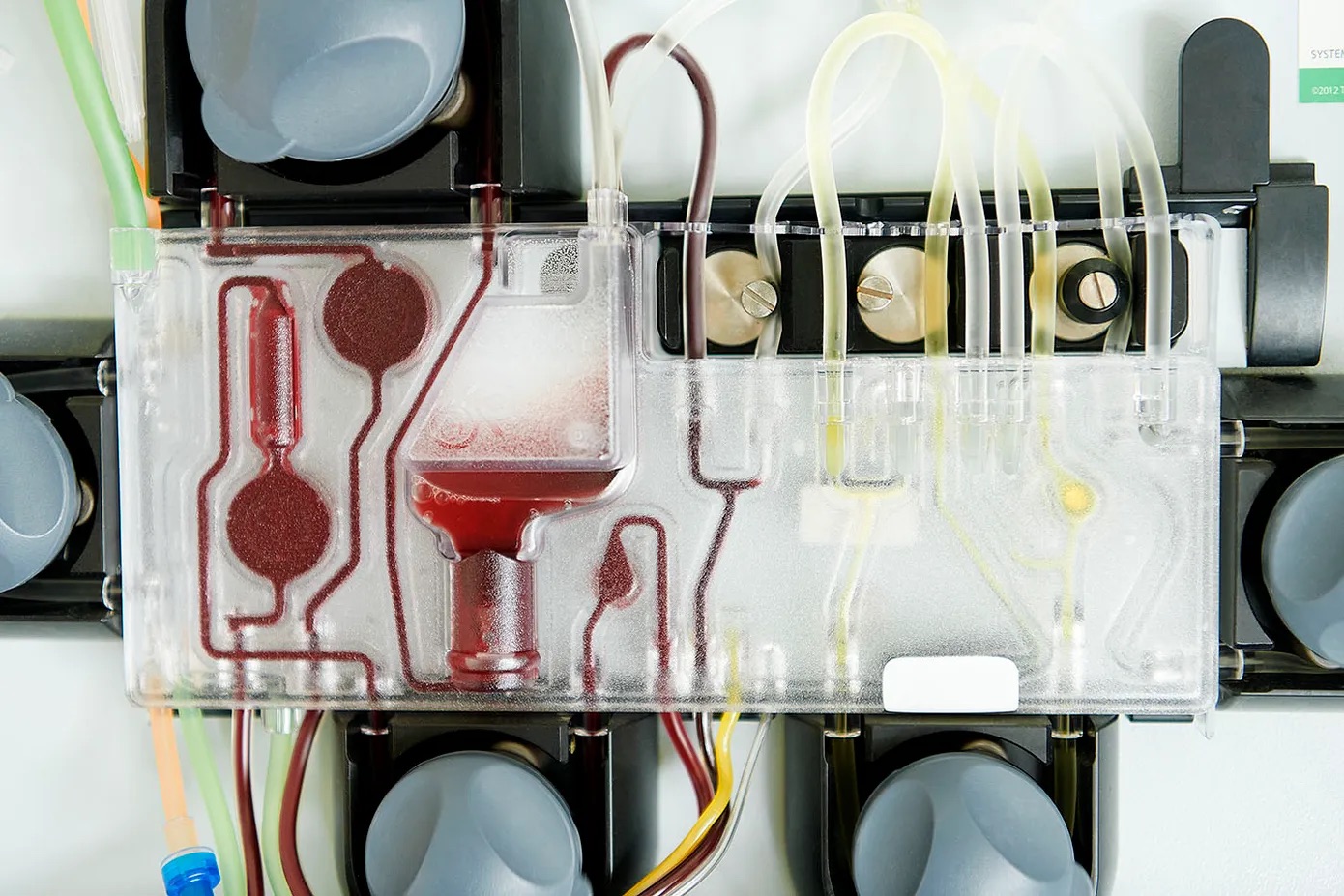
This is the "main event." The machine is running.
- Priming: The machine performs a self-check and primes the tubing with saline (takes ~5 minutes).
- Running: You sit back in a comfortable recliner. You can read, watch Netflix, work on your laptop, or nap.
- Duration Factors: The machine processes your blood in cycles. The speed depends on:
- Inlet Flow Rate: How fast we can pull blood out. A good vein might allow 60-80 mL/min. A smaller vein might limit us to 40-50 mL/min, extending the time.
- Total Plasma Volume (TPV): The amount of plasma we need to remove. This is based on your body size. A 200lb man has more plasma than a 110lb woman, so his exchange will take longer (e.g., 90 mins vs. 60 mins).
- Replacement Fluid: Albumin flows in easily. Thicker fluids (like FFP) might run slightly slower.
Phase 4: Rinse Back and Disconnect (10-15 Minutes)
We don't just stop the machine. We return your red blood cells to you.
- Rinse Back: The machine pushes saline through the tubing to "chase" the remaining blood back into your body. This ensures you don't lose any precious red cells.
- Disconnect: The needles are removed, and pressure is applied to the sites for 3-5 minutes to prevent bruising.
- Bandaging: A pressure dressing (Coban wrap) is applied.
Phase 5: Post-Procedure Observation (15 Minutes)
We don't rush you out the door.
- Hydration: You'll be offered water or juice.
- Vitals Re-check: We ensure your blood pressure is stable (sometimes it can drop slightly after fluid shifts).
- Calcium Check: The anticoagulant (Citrate) can lower calcium levels, causing tingling. If you feel this, we give you calcium (Tums or IV) and wait until it resolves.
Total Time: ~2 Hours (120 Minutes).
Factors That Can Extend the Time
While 2 hours is standard, be prepared for variances:
- Difficult Veins: If it takes multiple attempts to get a good IV, add 15-20 minutes. (Tip: Drink 1 liter of water before your appointment!).
- Alarms: The machine has sensitive safety alarms. If you bend your arm and kink the flow, it pauses. Frequent pauses add up.
- Reactions: If you feel lightheaded or nauseous, we pause the procedure, recline the chair, and give fluids. This is a safety measure, but it extends the time.
- Higher Volumes: Standard TPE exchanges 1.0 Plasma Volume. For severe autoimmune flares (like a Myasthenia Crisis), the doctor might order a 1.5 Volume Exchange, which takes 50% longer (add ~30-45 mins).
How Does TPE Compare to Other Therapies?
- TPE: ~2 Hours.
- Hemodialysis: ~4 Hours.
- IVIG Infusion: ~4 to 6 Hours (infusion rates must be slow to prevent headaches).
- Stem Cell IV: ~30-60 Minutes.
TPE is surprisingly efficient given the complexity of the task (filtering your entire blood volume!).
Making the Most of Your Time
Since you are in the chair for a while, we encourage you to use the time for yourself.
- Work: Our suites have high-speed Wi-Fi. Many executives take calls or clear their inbox.
- Relax: Bring noise-canceling headphones and listen to a podcast or meditation.
- Entertainment: We provide iPads with streaming services.
- Company: You are welcome to bring a companion, though they may be asked to step out during the sterile hook-up phase.
Conclusion
When planning for your TPE series, block out 2.5 hours in your calendar to be safe. This gives you a buffer for traffic, check-in, and a relaxed departure.
"How long does TPE take?" is a simple question with a personalized answer. At VIP TPE, we value your time. Our experienced nursing team prides itself on efficiency, high first-stick success rates, and getting you back to your day feeling rejuvenated—not drained.
Ready to schedule your session? Visit our Scheduling Page or call us to find a slot that fits your busy life.
Read more about the process: